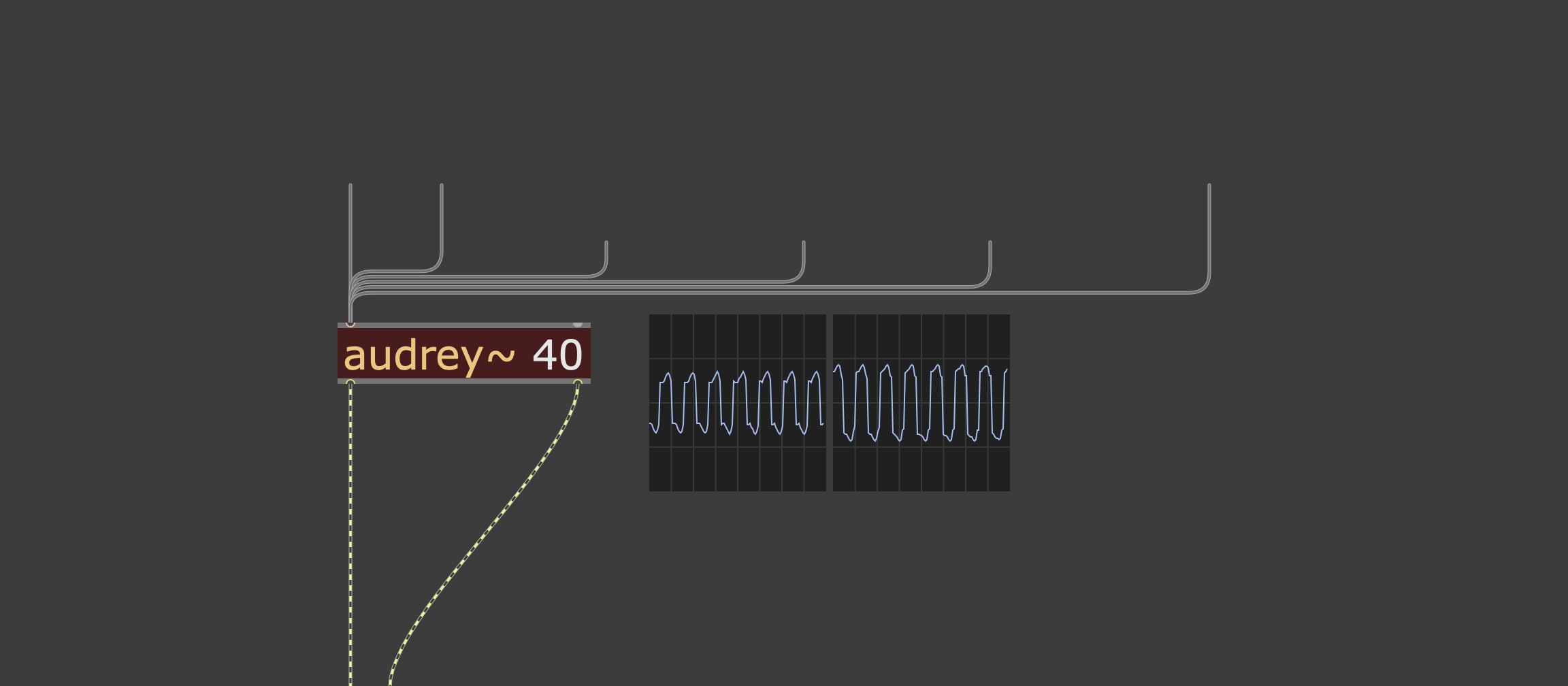
Audrey II is a DIY / open source synth project by Synthux Academy. They say “it is a powerful, feedback-driven synthesizer designed for exploring rich, analog-inspired soundscapes.” This sounds quite cool 🙂
The project consists of a standalone hardware that comes in it’s own little housing and software that runs on the Daisy platform.
It incorporates Karplus-Strong synthesis, reverb, filters, connected by a feedback path and a tape delay effect. The design was inspired by the sound and the physics of an electric guitar that feeds back to a cranked up amp. Here’s a video showcasing the synth and how it sounds:
Btw: Synthux Academy is a non-profit organisation based in the Netherlands that sits at the intersection of hardware design, open-source software, and education.
Looking a little closer at the sources, we can see that a pretty simple Karplus-Strong design is used for the simulation of a vibrating string. In a nutshell a Karplus-Strong algorithm incorporates a short delay line with high feedback settings and a lowpass filter in the feedback path to model natural damping of higher frequencies. The delay time marks the base pitch of the resulting sound. In Audrey II we can find two of these algorithms, so we have two independent strings for a nice stereo image, tuned to the same base pitch. To excite the vibration, a barely audible, tiny bit of white noise is injected.
The output of the string model feeds into a soft-clipping/distortion, passes through a filter section (HP/LP) and then goes into a reverb. The signal is fed back into the Karplus-Strong section via another delay line—effectively creating a resonator. Thus, when increasing the feedback level, self-oscillation sets in and creates heavenly overtone singing or rapidly grows into horrific screams …

I took the time and liberty to port this very nice open source project to Max, and added a few little tweaks, that are not available in the original hardware version:
- there’s a second audio input for true stereo processing of external signals
- the pitch range is greatly extended towards the bottom end, for extra nice crunchy lofi sounds at very low settings
- added a ‘drive’ parameter for adjusting the distortion/clipping behavior (try it with external input signals!)
- added smooth interpolation for parameter changes in EQ section
- added a ‘detune’ parameter for the two strings
- exposed two of the string parameters (‘decay_rate’ and ‘damping’) – these become especially effective with an external input signal
Might add more while working on it. So don’t consider this a final version, yet.
Here you can find the package containing externals compiled for mac and windows: audrey_tilde.zip
The sources for the Max package can be found on GitHub.
Let me know, if you find some use for it and feel free to share your results.
Happy feedback droning 🙂